*I received a copy from the publisher via Netgalley in return for an honest review. This in no way affected my opinion of the book.*
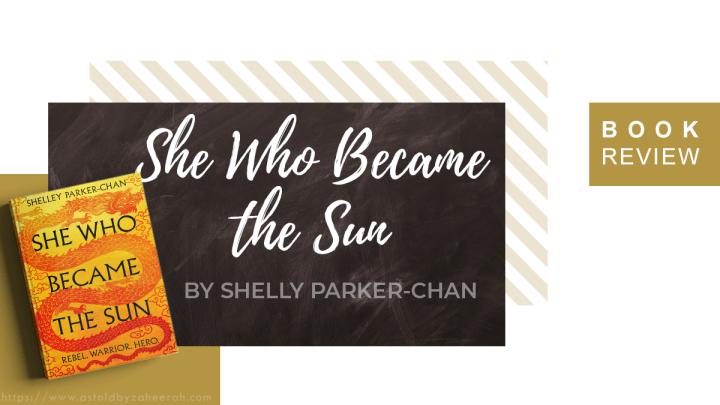
In 1345, China was under Mongol rule. For the starving Zhu family where only three members remain, their eight-born son, Zhu Chongba, is destined for greatness, a feat only capable by the few. But nothing is said for their daughter. When a bandit attack results in Zhu Chongba’s death, his sister takes on her brother’s identity to enter a monastery. There, in this alternate-history, she takes her opportunity to achieve what her brother failed to do: survive, and take control of a fate that would see her be nothing.
Judging from other early reviews, my expectations were through the roof. Pitched as Mulan meets The Song of Achilles and while that is a fair comparison, I just feel like there must be some other way to describe this. I’m quite literally speechless. I don’t think one book has ever shot up my all-time favourites list so quickly. Usually, I let a book marinate on my mind before casting a final judgment, but She Who Became the Sun didn’t need to wait. It was that good.
This book stands out because its character, each crafted and built to perfection, while not being entirely perfect. Zhu’s determination to survive is intense. Her peers at the monastery are confused by her actions, but what they don’t know is that she also has the ability to see ghosts, which loom over her in silent judgement. There is a cost to pay in her decisions, and she takes them head-on regardless of the reaction she knows she’ll inevitably receive because in the end, she knows what she wants and that is to rule. She might have been fated to be nothing, but she determined to let nothing stop her from achieving the goal her brother should have done. She is this perfect balance of driven and powerful while also being rather cheeky and very sweet. Zhu’s storyline introduces us to Xu Da, a fellow monk, who Zhu comes to see as her own family. Later, you’ll meet Ma, a young woman whose fierce compassion takes a toll within the backdrop of war and power-plays.
The story chronicles Zhu’s journey from monk to the leader of the rebellion against China’s Mongol rulers. But we also see the opposition in the form of eunuch Ouyang, a feared general who tore Zhu’s future apart and set him on a path that makes them intertwined. I was enthralled by his character the most. But the relationship between Ouyang and Esen, the prince of Henan, is so complex, considering the history behind them. Esen is much more optimistic than Ouyang, and can never seem to understand why his friend would keep his distance. The tension between them is just perfect.
The writing is so atmospheric, you could feel the impact of the landscape resonate with each character. Especially with Zhu as you witness her climb from a nameless child close to death to a well-rounded leader with men of her own. A child with no hope to a monk that can rally the people of this war torn land to her words. Also, I loved the nuanced exploration of gender identity, and how Parker-Chan does not shy away from anything. For anyone wondering, this is from the author: [Zhu] is assigned female at birth (but doesn’t identify as female), and [Ouyang] is assigned male at birth and identifies as male (with a gender nonconforming appearance). [Goodreads] I used she/her pronouns for Zhu as reflected in the novel.
Overall, She Who Became the Sun is one story you must watch out for. It’s bold, imaginative and highly thrilling. A fantastic reimagining of the founding emperor of the Ming Dynasty.
GOODSREADS | AMAZON | AUTHOR


 as told by zaheerah