
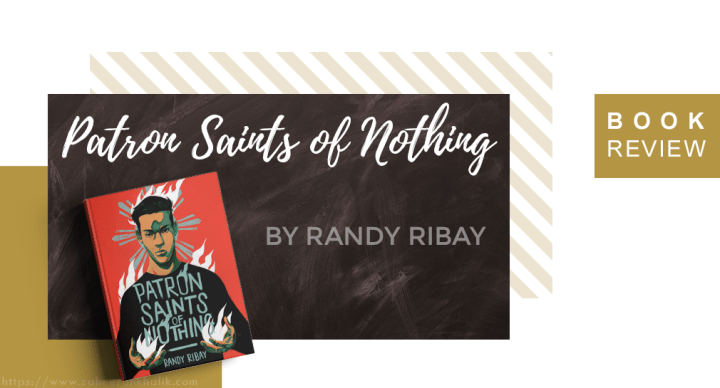
Rating: ★★★★☆ (4/5)
*I received a physical copy via the publisher in return for an honest review. This in no way affected my opinion of the book.*
I’m not sure where to start because there’s so much to this story. After discovering his cousin, Jun was murdered and fuelled by a mysterious Instagram message, Jay Reguero heads to the Philippines to find out the real story. There, Jay must reconnect with a life he barely remembers and family who refuse to acknowledge what has happened.
Told through a mix of narrations, switching between Jay and the letters addressed to him, Patron Saints was deeply emotional. It’s a coming of age story that really tugs at your heartstring.
If you don’t know much about Duterte’s war on crime, this book really sets the scene really well. It’s not going to hold your hand and tell you the violent history of Philippine’s current president, but it really highlights and summarises the political background Jay is set in really well. We get an understanding of the situation from different characters. And I thought it was discussed really well and didn’t shy away from controversies and really emphasises how the context impacts Jay and his search for the truth.
The story follows Jay as he’s moving from different family households in his visit to the Philippines. His extended family play a huge part in this story as we’re introduced to an army of aunties, uncles and cousins. I loved how it showcased how diverse family can be. Each house brought something new and helped Jay in his search. His uncle is a police officer who Jay suspects of being complicit in his son’s death. His rigid way of raising his children has his cousins opening up to him. He then moves in with his aunts, a lesbian couple, who are more caring toward Jay. Then he eventually comes to his grandparent’s house where everything that the story accumulated finally comes free.
Patron Saints tackles a lot of heavy subjects. It discusses colourism, the impact of American Imperialism, ethnocentrism and privilege. And that isn’t even all of it. The second Jay comes to the Philippines, he’s very much confronted with his more privileged way of living. He quickly realises how easier it is for him, a light-skinned man, to navigate the space he’s in. He even finds himself speaking overturn but is quick to learn and acknowledge the privilege he has.
The one thing that follows Jay in the Philippines is how much of an outsider he feels. A child of mixed heritage (White and Filipino), Jay is seen as very much whitewashed in the eyes of his family. After being away for much of his life, his family don’t see him as Filipino. I could really relate to Jay: having not knowing your country’s language, history or culture and feeling like an outsider at any given moment. I really think Ribay showcased the diaspora struggle and was dealt with spot on. His internal conflict was realistic and deeply emotional.
The only criticisms I could have are how Jun was treated and the character of Mia. The mistreatment of Jun, especially with his ending.
show/hide spoilersOverall, it was an illuminating and compelling story that delved deep into justice and grief and identity. It’s a coming of age novel that was character driven and offered an emotional and powerful punch. Rarely do YA novels tackle global issues that are often buried under Western domestic problems, and I found it an excellent read.
GOODREADS | AMAZON | BOOK DEPOSITORY | AUTHOR
Recent posts


