
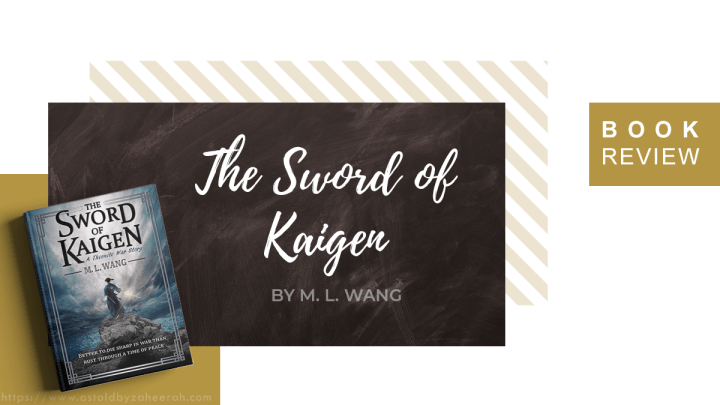
Review: The Sword of Kaigen

Review: The Sword of Kaigen

Rating: 5 out of 5.

Upon the highest mountains live the fighters of the Kusanagi Peninsula, whose bloodline has kept the Kaigenese Empire safe for centuries, earning them the title ‘The Sword of Kaigen.’ The Matsuda family are a true testament to the title, with their eldest born, Mamoru, growing stronger each day. But when the enemies return to their shores, are they truly prepared to fight when they discover their Empire may have been built on lies?

I cannot tell you how many times I have tried to write this review without it turning into an incoherent paragraph of emotions. This is the book I should’ve read on my deathbed because how on earth am I supposed to move on from this?

The Sword of Kaigen follows the Matsuda family, primarily its eldest, Mamoru, and his mother, Misaki. Like the other families around them, they can manipulate water, and the Matsuda’s are famous for their bloodline technique, Whispering Blade, a move so sharp that ice can cut steel. The pressure is on for Mamoru, who begins to feel the heaviness of the Matsuda name and finds his world turned upside down when his new school friend teaches him that the Empire, he was raised to serve has been lying to him all this time. His mother, Misaki, holds her own secrets; a past from before her marriage to Takeru Matsuda haunts her when war returns to their shores.

When defining a ‘character-driven book’, I believe we should also include The Sword of Kaigen in the explanation. M.L. Wang has done remarkably well, almost perfectly, regarding the cast of The Sword of Kaigen. Mamoru, the sweetest boy, only wants to protect his home. Misaki is a skilled woman who fights to rise above traditions when she can no longer abide by its rules. Even Takeru, her stone-cold husband, flipped my perception drastically from the first time we met. While I loved Mamoru as my own, Misaki is the novel’s showstopper. Having been a fighter in her youth, she has closed off her past to her children and witnessing her son see the truth for the first time, she finds herself reminiscing on her past, and the fighting soul within her returns to the surface. She grows tired of listening to people who wish for her silence and watching her come back to life could be a novel in its own right.

I have learnt from other reviews that the story’s pacing is often a common critique that is most brought up. Still, I found the unconventional pacing added to the emotional impact and reading experience. The story starts slow, quite literally the calm before the storm. Change slowly occurs, mainly through Mamoru’s POV, a young boy discovering that his Empire was suppressing the truth from his family. Not everyone is happy to hear him speak indifferently of their Empire, especially his father, Takeru. Misaki does her best to allow her son to understand the truth without overstepping. The development of their mother-son relationship was tender and heart-breaking,

When the action hits the page, it hits hard. It is messy; no one is truly prepared for what is to come, and the invasion confuses even the strongest warriors. The fighting barely takes up much of the story, but its effect ripples all the way to the final page. While some of the best moments happen outside of the fight, Wang’s ability to write action sequences is brilliant – so much vivid and insightful descriptions that I felt like I was watching a visual novel unfold. I was speechless throughout it all.

Overall, I finished this book with sheer admiration for M.L Wang as there are not many authors whose stories give me such whiplash that I can’t stop thinking about it even months after. I learnt not long after that Wang has chosen not to continue in this universe, and while I was shocked to hear this, I am grateful for what we’ve been given already. An all-favourite that I will cherish dearly.

GOODREADS | AMAZON | AUTHOR

Review: Mammoths at the Gates (The Singing Hills Cycle, #4)

Review: Mammoths at the Gates (The Singing Hills Cycle, #4)

Rating: 5 out of 5.

*I received a copy from the publisher via Netgalley in return for an honest review. This in no way affected my opinion of the book.*

Cleric Chih returns home for the first time in years only to discover their mentor has passed away and his granddaughters are threatening the safety of the Singing Hills Abbey to retrieve his body. Chih must work quickly to honour their mentor’s life while stopping the mammoths at the gates from destroying everything the clerics have worked for all these years.

While the author notes that the series may be read in any given order, each release can be considered its entry point; Mammoths at the Gate feels like such a brilliant story that fits easily as the middle story of Chih’s journey. (We are, thankfully, getting more from Cleric Chih. I don’t think I’m ready to let them go yet.)

Chih has turned home for the first time in almost three years. However, the Abbey is silent as ever, as most of the clerics are elsewhere, and the few left are undoubtedly incapable of handling the giant mammoths that could trample them in seconds. Chih barely has time to truly mourn their mentor as they are spurned to stop the war at their doorstep. But Chih isn’t the only one mourning. The mammoths are controlled by the granddaughters of their mentor, Cleric Thein, the family that he left behind once he joined the singing hills, the other clerics, some old friends of Chih, some new, and not to mention Cleric Thein’s hoopoe companion, Myriad Virtues.

Life and death and how it is passed through stories is the core element of this series, and Chih is now a character instead of a bystander this time around. This novella deals tightly with grief and change, and Mammoths at the Gate is emotional and heartfelt. Sure, Chih has shown emotions, but seeing them return to their home, to their familiar surroundings and realising how much has changed in the time they were gone felt so much more affecting.

As clerics, they understand how memory is a fickle thing, and how it used to remember the life of Cleric Thein before and after his time as a cleric was an excellent way to touch upon the topic of grief and the grieving process. His granddaughters recall a much different person than Chih, but it doesn’t mean their perspective is wrong; it reminds them that the world is constantly changing. The stories about you, too, can affect people differently. All in all, this is my favourite entry in the series so far. Simply well done and beautiful.


GOODREADS | AMAZON | AUTHOR

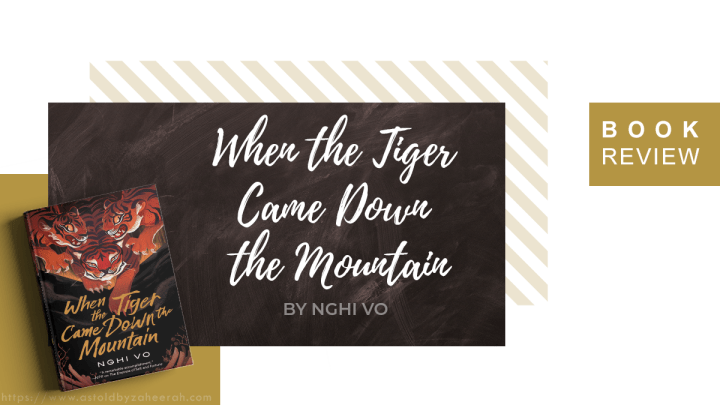
Review: When the Tiger Came Down the Mountain (The Singing Hills Cycle, #2)

Review: When the Tiger Came Down the Mountain (The Singing Hills Cycle, #2)

Rating: 5 out of 5.

Cleric Chih and their new companions find themselves in an unsafe situation, and to stay alive, Chih must recount the story of the tiger and her scholar lover to survive the night. But they must watch their words as one mishap may unleash the anger of the ferocious tigers who listen closely on.    

In my previous review of The Empress of Salt and Fortune, I referred to the story as a “near-epic tale, all condensed into a hundred pages.” While the stakes are not as high this time, I found When the Tiger Came Down the Mountain an exceptional sequel that captivated me way more than the first in such a drastic way. My third foray into Nghi Vo’s work, and I am mesmerised by her storytelling skills.

Chih takes the stage this time and tells the story of tiger Ho Thi Thao and the scholar Dieu and finds themselves at the mercy of the tigers, who interject to explain how their version of the same story happened. The Singing Hills Cycle series, at its core, is about the power of storytelling, and this novella particularly emphasises how history is remembered by the winners. The mediation between Chih and the tiger sisters is thrilling and frightening. Chih is cut off at many points in their recollection of the story by the tigers to correct or disagree with their rendition of the story, new information that shifts Chih’s entire perspective of the tale and makes them even more on edge as they wait out the night.

Nghi Vo’s ability to command words is enthralling. Stuck on a cold mountain, the clock ticking until sunrise, readers can expect to feel like they’re sitting along Chih, anxiously watching their every word, hoping it’s not their last, listening to the love story of Ho Thi Thao and Dao, a sapphic tale between two complicated women. Nghi Vo knows how to keep readers captured, creating fully realised stories in such a tight number of pages. Something about this series so far makes me feel at peace. Much like its predecessor, When the Tiger Came Down the Mountain was glorious, and Nghi Vo’s storytelling has won my heart and soul. I highly recommend and eagerly await more about our beloved cleric, Chih.


GOODREADS | AMAZON | AUTHOR

Review: Exit Strategy

Review: Exit Strategy

Rating: 5 out of 5.

In the final novella instalment, Murderbot finds its way home to rescue its former owner, Dr. Mensah, who is being held captive by GrayCris. Having previously collected incriminating evidence, Murderbot can no longer hide under the shadows as GrayCris continues its very public attack on Dr Mensah’s character and even goes as far as kidnapping her as a threat to the Preservation Alliance to drop its litigation case.

But hell hath no fury like a self-aware SecUnit scorned, and Murderbot begins its own rescue operation, rejoining with Mensah’s old colleagues and launching an offensive attack on GrayCris. Throughout the novellas, Murderbot slowly grows its case against GrayCris, and their illegal activities and the result makes for an exhilarating final battle against corporate greed: both physical and mental, as Murderbot turns the system on itself in a near cinematic moment that blows me away. The finale fight felt like its own form of theatre, and I was a mere audience member in the front view, soaking it all in.

Murderbot is determined against all odds to save Dr Mensah or die trying. Exit Strategy is the breath you’ve been holding all along in the series. And when the dust settles, Murderbot knows it still has a long way to go. Exit Strategy wraps up the GrayCris arc with a satisfying and entertaining conclusion. But Murderbot’s story is far from over, and I’m super excited to see where their intergalactic journey will take them next.


GOODREADS | AMAZON | AUTHOR

Review: Rogue Protocol

Review: Rogue Protocol

Rating: 5 out of 5.

Martha Wells continues her thrilling journey of the highly entertaining and most complex AI around. (Sorry, ChatGPT, take a seat this time) In Rogue Protocol, Murderbot finds itself on a new task, seeking evidence against the sinister corporation GrayCris.

The story picks up with Murderbot on its way to a transit station, almost forgotten in a hyper-connected society, hoping to find evidence against GrayCris and help Doctor Mensah (who we first meet in All Systems Red) in her case against the entity for its safety violations. 

Rogue Protocol might just be my favourite out of the novellas in this series. While I prefer the previous novellas’ quieter introspection, Murderbot is pushed to the limits in this one as it’s a lot more action-packed and adventurous. As usual, Murderbot navigates the complexities of human emotions while dealing with its growing anxieties, but this time with the ever-increasing threat of GrayCris hovering closer in their mind, as it notes that people have begun to question its disappearance from the public eye.

After adopting its human persona again, Murderbot’s cover is almost completely ruined when it realises another research group has their own security bot called Miki, who can detect Murderbot’s presence if they’re not careful. So, it convinces Miki that it is a hired help to ensure Miki’s group’s survival.

In Artificial Conditions, we see how Murderbot understands its fellow AI counterparts, understanding its different needs and expectation from their contractors, but Miki is different. Miki is treated as part of the team, even referring to them as her friends. For once, Murderbot can almost wonder what life could be like if they didn’t see it as a mass murderer.

Wells continues to develop and improve upon Murderbot as an engaging and hilarious character, its thought processes dive deeper into its struggle with identity and relationships. Overall, Rogue Protocol is incredibly engaging and another captivating instalment in the adventures of Murderbot. As we step closer to the dangerous reach of GrayCris, you can’t help but root for the snarky SecUnit who can’t seem to catch a break.


GOODREADS | AMAZON | AUTHOR

Review: Artificial Conditions

Review: Artificial Conditions

Rating: 5 out of 5.

With only the vaguest memories of its past, Murderbot departs from its former crew and teams up with a Research Transport vessel named ART to undercover its history of a former mining facility.

We return to our beloved SecUnit, now disguised as a security consultant, who embarks on a journey to remember its past, once swiped from its memory. How can it convince anyone it must make its way to a derelict facility that shouldn’t exist anymore? So, they hitch a ride with an empty cargo, trading its precious hours of media, and take a job as a security guard for a group of researchers planning to find their stolen work in the same area.

Wells excels in her portrayal of both complex and memorable characters. Artificial Conditions focuses mainly on Murderbot and their newest (and biggest headache) companion, ART. Murderbot is, as always, sarcastic and endearing. The dynamic between Murderbot and ART is surprisingly fascinating. While All Systems Red touches upon the existence of other bots, Artificial Conditions introduces them to the forefront. I enjoyed how Murderbot’s characterisation of their robot peers is extremely endearing and incredibly humanised.

Artificial Conditions is an exciting departure from the first story, as Murderbot hacks its way through systems to find out what caused its malfunction, resulting in the deaths of over 50 people. Wells expands her universe into a rich world with a brilliant blend of futuristic technology and complex, grounded characters. Continuing its witty quips with an even more engaging story, Artificial Conditions is an entertaining addition to the series.


GOODREADS | AMAZON | AUTHOR